
The Future of Micellar Science: Surfactant Breakthroughs
Abstract:
This experiment investigated why micellar water removes makeup more effectively than normal tap water. Many makeup products contain oils and other substances that do not dissolve in water. Micellar water contains special molecules called surfactants that form tiny clusters known as micelles. These micelles have a hydrophilic outer layer and an oil-attracting center, which allows them to trap and lift oil-based makeup from the skin. Tap water does not contain surfactants, so it cannot break down or remove oily substances as effectively. Results showed that micellar water removed more makeup in less time compared to water alone. These findings demonstrate that micelle formation and the presence of surfactants are key factors in effective makeup removal.
Introduction:
Surfactants are chemical compounds that help mix substances that normally do not combine, such as oil and water. They are commonly found in soaps, detergents, and cleansing products. Surfactant molecules have a unique structure with two ends: a hydrophilic head and a hydrophobic tail. This dual structure allows them to interact with both water and oily substances at the same time.
When surfactants are added to water, they can arrange themselves into tiny spherical structures called micelles. In a micelle, the hydrophobic tails point inward toward trapped oil or grease, while the hydrophilic heads face outward toward the surrounding water. This structure allows micelles to surround and lift oil-based substances so they can be rinsed away. Without surfactants, water alone cannot effectively remove oily materials because oil does not dissolve in water.
Methodology/procedure:
To begin the experiment, the left and right underarms were designated as separate test areas to compare two cleansing methods under similar conditions. A liquid foundation was applied evenly to both underarms to ensure consistency in the amount and coverage of makeup. The foundation was left on the skin for approximately 8.5 hours from 8:00 a.m. to about 4:30 - 5:00 p.m. to simulate a full day of wear.
After the set time period, makeup removal testing began. The left underarm was cleansed using tap water only, while the right underarm was cleansed using micellar water. For consistency, one cotton pad was used per trial for each side. About 1/4 of a teaspoon of the assigned liquid was applied to the cotton pad. The cotton pad was then pressed against the skin using even pressure and moved across the area using one swipe at a time.
The number of swipes required to completely remove the visible foundation was recorded for each method. Care was taken to apply equal pressure and similar motion on both sides to maintain fairness in the experiment. This process was repeated, and the results were recorded over five consecutive days to ensure consistency and improve the reliability of the data. This procedure allowed for a direct comparison between tap water and micellar water in their effectiveness at removing oil-based makeup.
Results:
The number of swipes required to completely remove the foundation was recorded over 5 days for two participants. For person 1, the number of swipes required using tap water was 13, 14, 14, 15, and 14. When micellar water was used, the number of swipes decreased significantly to 3, 4, 3, 3, and 4. For person two, tap water required 14, 14, 15, 14, and 14 swipes across the 5 days. In comparison micellar water required only 3, 4, 4, 3, and 4 swipes.
To better compare the results averages were calculated person one required an average of 14 swipes using water in an average of 3.4 swipes using micellar water person 2 required an average of 14.2 swipes using water and an average of 3.6 swipes using micellar water. overall tap water required approximately four times more swipes than my cellar water to fully remove the foundation.
The data remained constant across all five days for both participants showing very little variation. Water consistently required between 13 and 15 swipes while micellar water consistently required only 3 to 4 swipes this clear and repeated difference demonstrates that micellar water was significantly more effective at removing oil-based foundation than tap water alone.
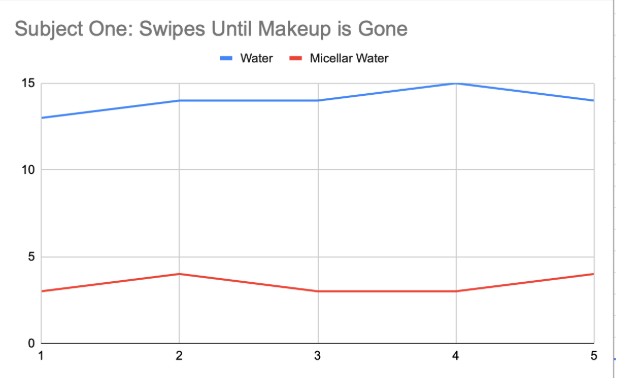
[Figure 1]: For Subject One, the amount of swipes needed to remove the makeup completely in one sitting was recorded. Over the span of 5 days (x axis), the amount of cotton pad swipes (y axis) needed to remove the foundation, using test subjects Water and Micellar water.

[Figure 2]: For Subject two, the amount of swipes needed to remove the makeup completely in one sitting was recorded. Over the span of 5 days (x axis), the amount of cotton pad swipes (y axis) needed to remove the foundation, using test subjects Water and Micellar water.
Conclusion:
The results of the experiment demonstrate that surfactants and micelle formation greatly improved the removal of oil-based makeup compared to tap water alone. Across five days of testing with two participants, micellar water consistently required far fewer swipes to completely remove foundation than water. While tap water required an average of about 14 swipes, micellar water required only about 3 - 4 swipes. This significant difference supports the idea that water alone cannot effectively dissolve oily substances, whereas micellar water can.
The effectiveness of micellar water can be explained by the presence of surfactant molecules. These molecules form micelles, which have hydrophilic heads and hydrophobic tails that trap oil and makeup particles. Since tap water does not contain surfactants, it cannot surround and lift oil-based foundation in the same way. As a result, more swipes were needed to remove the makeup when only water was used.
For future research, it would be valuable to compare different brands of micellar water to determine whether higher surfactant concentrations further improve removal efficiency. Additionally, testing other oil-based cosmetic products, such as waterproof mascara or sunscreen, could help determine whether the effectiveness of surfactants varies depending on the type of product being removed. These investigations would provide deeper insight into how surfactant chemistry influences cleansing performance.
References (APA):
- 1.20.2: Surfactants and Micelles. (2022, July 29). Chemistry LibreTexts. https://chem.libretexts.org/Bookshelves/Physical_and_Theoretical_Chemistry_Textbook_Maps/Topics_in_Thermodynamics_of_Solutions_and_Liquid_Mixtures/01%3A_Modules/1.20%3A_Surfactants/1.20.2%3A_Surfactants_and_Micelles
- Cleansing Products in Cosmetic Science. Cosmetic Science. (2024, September 9). https://cosmeticscience.net/cleansing-products-in-cosmetic-science/